

Global Supply Chains Transforming Through AI, ESG Mandates, and Geopolitical Fragmentation
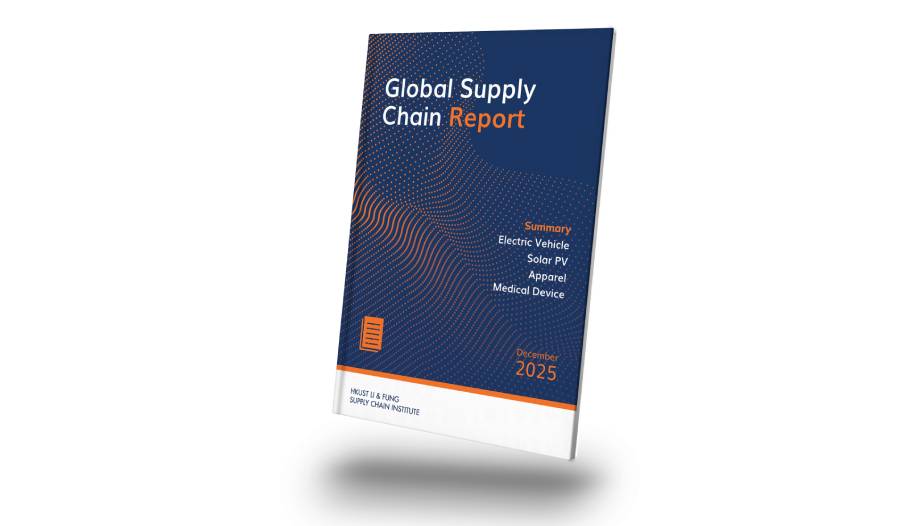
Hong Kong, 9 December 2025 — The HKUST Li & Fung Supply Chain Institute ("the Institute") released Global Supply Chain Report 2025, at the Global Supply Chain Summit and Conference 2025 today, revealing that efforts to reduce China dependence are paradoxically driving a new wave of Chinese enterprise internationalization rather than decoupling.
The report examines electric vehicle, solar energy, apparel, and medical device industries to show how geopolitical tensions, artificial intelligence and mandatory ESG regulations are reshaping global manufacturing and sourcing patterns.
Helen Chin, Head of Research of the Institute, said: "The most striking finding is that trade barriers intended to reduce China dependence are triggering the opposite effect—accelerating Chinese manufacturing capital and technology diffusion globally. Chinese enterprises are evolving from suppliers to multinational coordinators with localized production across Southeast Asia, the Middle East, North Africa and Europe, while retaining control over technology, brands and upstream materials. This represents a profound transformation in how global supply chains operate—not decoupling, but more complex interdependence."
Chinese Enterprises Going Global: Redefining Supply Chain Geographies
The report finds that Chinese enterprises are shifting from a traditional "world's factory" role to becoming global orchestrators of production networks across EVs, solar, apparel and medical devices . Rather than retreating under tariffs and trade restrictions, leading firms are building manufacturing bases, R&D centres and logistics hubs in Southeast Asia, South Asia, the Middle East and North Africa, Europe and the Americas, creating regionally anchored but globally connected supply networks.
In EVs, Chinese carmakers and battery producers are investing in large-scale plants in Europe and ASEAN while securing upstream minerals through projects in Indonesia and Africa . In solar, major manufacturers are relocating entire vertically integrated supply chains—from polysilicon and wafers to cells and modules—to Southeast Asia and MENA to preserve market access and manage trade-remedy risks . In apparel and medical devices, Chinese firms are developing overseas industrial parks, brands, R&D labs and local manufacturing to move up the value chain and compete directly with established incumbents . Through this strategy, Chinese firms maintain control over critical materials and technologies while distributing production to meet regional policy requirements and market access rules.
Technology: From AI to Materials Innovation, Redrawing Power in Supply Chains
The report highlights that technology is reshaping global supply chains not only through artificial intelligence and automation, but also via rapid innovation in materials and key components across all four industries. AI is transforming how companies design products, plan production, manage inventory and monitor quality in real time, while advanced robotics and smart factories are changing the economics of where it makes sense to produce.
Equally important, firms are racing to develop new materials and components that deliberately change supply chain dependencies. In EVs, shifts in battery chemistry and the move towards rare-earth-free motor designs aim to reduce reliance on a small group of suppliers and countries dominating critical minerals and magnet production. In solar, next-generation cell and module technologies, coupled with more efficient manufacturing processes, are altering which locations and firms are indispensable in the value chain. In apparel, innovative textile fibres and functional fabrics, often developed alongside new machinery, can lock in specific upstream partners while enabling brands to differentiate on performance and sustainability. These technological shifts do not simply improve efficiency—they reshape bargaining power within supply chains, determining which countries and companies can be substituted and which become harder to replace.
ESG Mandates Drive New Location Criteria
Environmental, social and governance considerations have transitioned from voluntary commitments to binding requirements reshaping where companies can profitably operate . The EU is leading this shift through interconnected regulatory frameworks such as the Digital Product Passport, Carbon Border Adjustment Mechanism and EU Batteries Regulation.
The report argues that traditional cost-driven arbitrage is reaching its limits as ESG requirements reshape location decisions. Companies can no longer simply choose the cheapest location—they must prioritize locations with verifiable carbon footprints and ESG infrastructure that meet regulatory requirements . This favours countries investing in renewable energy grids, circular economy infrastructure and traceability systems, while creating barriers for manufacturers relying on carbon-intensive production or unable to document supply chain provenance . As these EU standards become a global benchmark, with similar regulations emerging in other jurisdictions, ESG capability is becoming a prerequisite for accessing premium markets.
Wiliam Kong, Manager of the Institute, said: "We're witnessing the end of simple cost-driven sourcing decisions. As ESG regulations become mandatory, competitive advantage is fundamentally shifting—from cost-based to compliance-based manufacturing."
Nearshoring Shows Mixed Progress; Tariff Volatility Stalls Investment
Nearshoring has achieved notable success where geography, trade agreements and industrial ecosystems align. The report points to medical devices in Central America and automotive production in Mexico as examples of genuine traction, supported by regional proximity, established infrastructure and preferential trade frameworks. Mexico overtaking China as the largest U.S. goods exporter illustrates that nearshoring can work when conditions are favourable.
However, the report also finds significant structural constraints. In apparel, proximity and trade agreements alone cannot overcome gaps in textile ecosystems and supplier networks built over decades in Asia. More critically, tariff volatility and uncertain implementation timelines have prompted many investors to adopt a wait-and-see approach, freezing or delaying new capacity in nearshoring destinations. The report concludes that nearshoring succeeds where three conditions converge: robust industrial infrastructure, stable policy frameworks and products requiring speed-to-market logistics; where these are absent, established Asian supply chains continue to dominate sourcing decisions.
Beyond documenting current transformations, the report offers three forward-looking scenarios through 2030—Fragmented Blocs, Resilient Diversification, and ESG-Driven Transformation—each presenting distinct implications for how businesses should structure their supply chains and how policymakers can foster competitive yet resilient industrial ecosystems.
Global Supply Chain Report 2025 is now available at https://ustlfsci.hkust.edu.hk/reports/global-supply-chain-report-dec-2025 .