

Chinese Commercial Sector Positioned for Transformation in 2026
Release of Ten Highlights of China’s Commercial Sector 2026
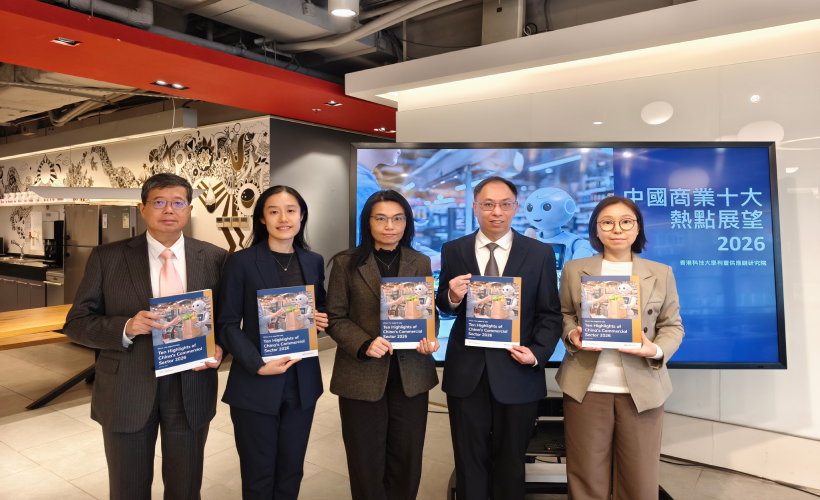
Hong Kong, 20 January 2026 — The HKUST Li & Fung Supply Chain Institute (“Institute”) today releases the 23rd edition of its annual report, Ten Highlights of China’s Commercial Sector 2026 (“Ten Highlights”). Coauthored with the Expert Committee of the China General Chamber of Commerce, the report identifies the top trends set to shape China’s commercial landscape as the country enters the opening year of the 15th FiveYear Plan period (2026–2030).
According to the Institute, 2026 will be a pivotal year of structural transformation rather than just incremental growth. China’s commercial sector is expected to maintain steady expansion, underpinned by policies to expand domestic demand, deepen digitalization, accelerate green transformation and foster high‑quality, innovation‑driven development. These efforts are expected to reinforce China’s position as the world’s second‑largest consumer market, with total retail sales of consumer goods projected to grow by around 4.5% yoy in 2026. China’s GDP is forecast to record solid, policy‑supported growth at 4.7%, reflecting stable fundamentals and a continued rebalancing towards consumption‑driven expansion.
Mr. Chang Ka Mun, Executive Director of the Institute, says, “2026 is not just another year of growth—it is a year of structural transformation. The government’s blueprint for the 15th Five-Year Plan signals a continuous shift towards quality-driven development, digital empowerment, and sustainability. Enterprises that embrace these priorities and innovate across formats and channels will lead the next wave of competitiveness.”
Ms. Helen Chin, Research Head of the Institute, adds that “Consumer behaviour is evolving rapidly, with emotional value, integrated experiences, and green lifestyles becoming mainstream. Businesses that leverage AI, digital platforms, and data-driven insights to deliver personalized, immersive experiences—while aligning with national goals on green, inclusive and high‑quality development—will capture the strongest momentum in this changing landscape.”
In 2025, the sector demonstrated resilience amid economic uncertainties, with notable progress in digitalization, service consumption, and sustainability. Looking ahead, 2026 will see intensified efforts to integrate commerce with culture, tourism, and sports, while new quality productive forces—such as advanced technologies and data-driven models—reshape circulation systems. Emotional and stratified consumption patterns are also gaining momentum, reflecting evolving consumer values across generations.
The report also highlights opportunities in county-level commerce, which is emerging as a key driver of urban-rural integration and rural revitalization. Meanwhile, Chinese brands are accelerating their global expansion, leveraging cross-border e-commerce, localized strategies, and AI-powered supply chain solutions to build new trade momentum.
The report also discusses the global expansion of Chinese retail enterprises. Together, it forecasts the following ten key highlights for 2026:
- CPC recommendations for the 15th Five-Year Plan outlines development blueprint for China’s commercial sector
- Government works to expand consumer market and refine mechanisms to boost consumption
- New quality productive forces transform China's commerce and circulation sector
- Commerce-culture-tourism-sports integrated experiences and AI unlock new service consumption momentum
- Green consumption evolves from policy push to market pull through digital innovation and multi-generational engagement
- China's retail sector embraces multi-format innovation and quality enhancement
- China’s catering industry enters multi-dimensional transformation and value reconfiguration
- Reshaping county-level commerce to power urban-rural circulation and rural revitalization
- Self-pleasing, stress relief, and quality upgrades drive a new era of stratified consumption
- Multi-faceted push to accelerate 'going global' and build new trade momentum