

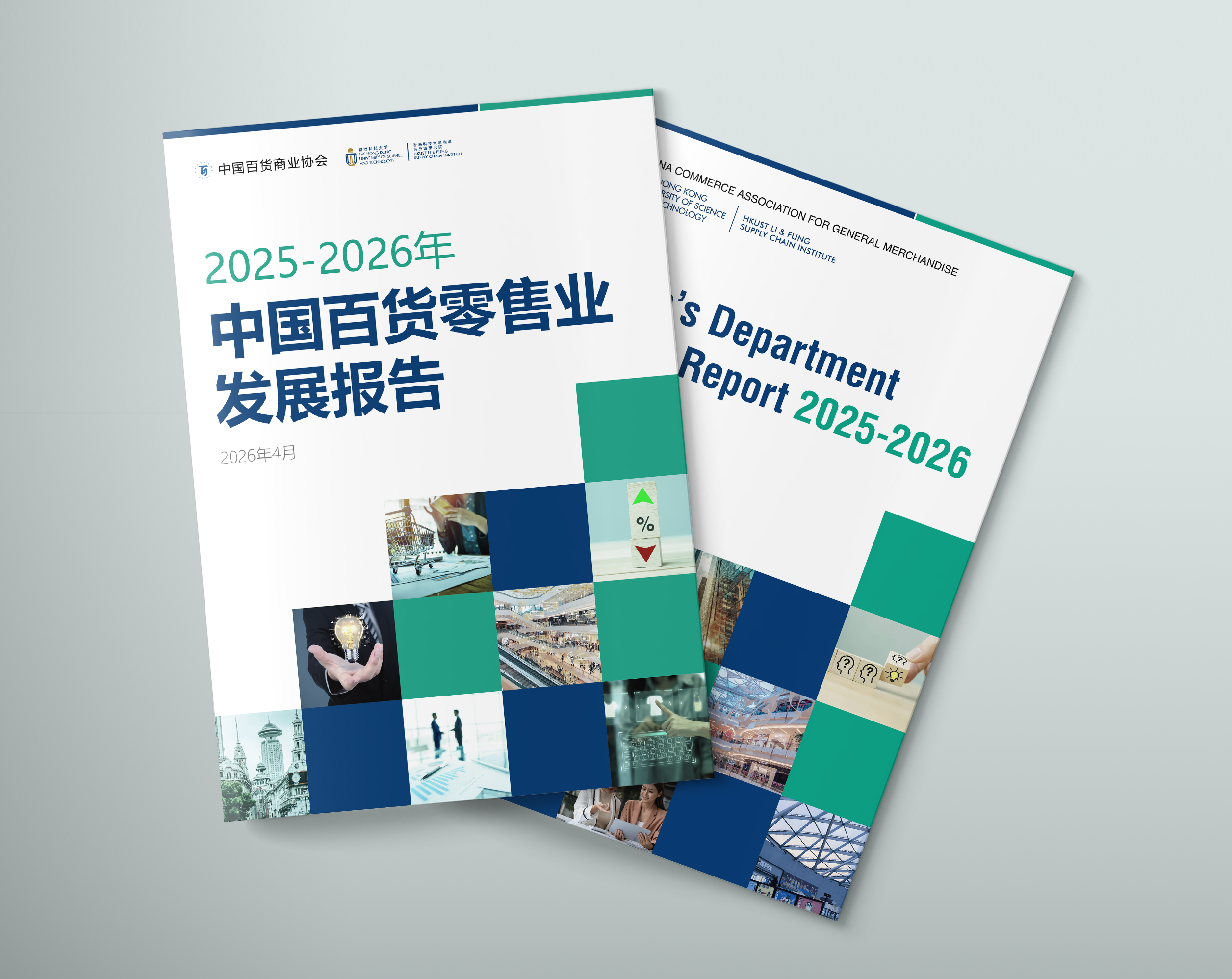
China’s Department Stores Face Structural Optimization as Transformation and Upgrades Continue
Release of China’s Department Stores Report 2025-2026
The HKUST Li & Fung Supply Chain Institute (“Institute”) and China Commerce Association for General Merchandise (“CCAGM”) today jointly released the China’s Department Stores Report 2025-2026 (the “Report”). The Report shows that China’s macroeconomy maintained steady growth in 2025, with GDP expanding 5.0% year-on-year (yoy) and total retail sales of consumer goods surpassing RMB 50 trillion. The Institute forecasts that China’s GDP and total retail sales of consumer goods will grow by 4.7% yoy and around 4.5% yoy, respectively, in 2026. However, the department store industry has come under multiple influences from changing consumer demands, diversion of traffic to online channels, and the restructuring of brand distribution channels, entering a stage of deep transformation focused on revitalizing existing stores and restructuring business formats.
This marks the 11th consecutive year of publication for this report series. Based on a joint survey conducted by the CCAGM and the Institute, the department store industry in 2025 showed a severe trend of simultaneous decline across four key metrics—sales, profit, customer traffic, and average transaction value. More than 60% of the surveyed enterprises reported a decline in sales and net profit. About half of the enterprises experienced a drop in customer traffic and average transaction value. The survey also reveals that most of the enterprises identified “insufficient consumer spending and consumption downgrading” as their primary challenge. They also face pressures from high operating costs and sustained competition from Internet platforms, e-commerce and live-streaming commerce, etc. At the same time, supply-demand mismatch was also prominent: issues such as weak product competitiveness, difficulty in meeting customer needs, insufficient in-store experiences, etc. reflect the industry’s obvious shortfalls amid a structural shift in consumer demand.
Despite the challenging environment, a number of leading department store operators managed to maintain robust development through differentiated positioning and experience-driven innovation. Premium department stores such as Beijing SKP and Nanjing Deji Plaza continued to expand their luxury and first-to-market brand portfolios, firmly retaining high-net-worth customers. Shanghai Jiuguang Centre, Wushang MALL, Guangzhou Teem Plaza and others integrated diverse formats—including art exhibitions, family-oriented leisure activities, and immersive entertainment—into their retail spaces, with hundreds of cultural and IP events throughout the year effectively drawing younger shoppers. Rainbow Department Store and Intime Department Store expanded their omnichannel capabilities, connecting online stores, on-demand retail, and livestreaming commerce to establish a stable second growth engine, providing a replicable transformation model for the industry.
Against a backdrop of industry adjustment and consolidation, the wave of mergers and acquisitions (M&A) has been characterized by “cross-sector dominance and external entry”. More than 30% of surveyed enterprises expect M&A activity in the industry to continue increasing and polarizing in the coming years. Landmark transactions such as Youngor’s acquisition of Intime Department Store and Boyu Capital's stake in Beijing SKP are emblematic of the deep reshaping of the competitive landscape, as companies and investors with financial strength and operational capabilities reshape the sector by integrating quality department store assets.
Looking ahead to 2026, the department store industry as a whole is showing signs of a cautious recovery. More than 40% of surveyed enterprises expect sales growth in 2026, while around 40% expect sales to remain broadly flat, indicating a significant easing of concerns about a sharp decline. Looking forward, many surveyed enterprises consider “stepping up transformation and upgrades” to be the top priority for the next three years. Department stores are expected to trend towards a shopping-centre model, and community retail will become an important future direction. By building a multi-tiered commercial network of “flagship projects in core commercial districts supplemented by community convenience outlets”, consumers across all shopping scenarios can be served.
This year’s Report features a dedicated chapter systematically examining the history, current state, and challenges of digitalization in the department store industry. The survey shows that majority of enterprises have launched WeChat Mini Programs stores, livestreaming channels, and developed presence on public domain platforms such as Douyin and WeChat Official Accounts—digital operations have become standard practice across the industry. However, there remains room to deepen digitalization: most of the enterprises have not fully integrated member data and traffic across all their business formats and platforms, and data silos remain a critical bottleneck in the industry’s digital transformation.
Ms. Helen Chin, Head of Research at the HKUST Li & Fung Supply Chain Institute, states: “In 2025, the department store industry continued to face pressure across sales, profit, customer traffic, and average transaction value, even against a backdrop of steady macroeconomic growth. Against this backdrop, transformation and upgrading have shifted from being an option to being an imperative. Whether the focus is on restructuring business formats, refreshing retail experiences, or enabling end-to-end digital capabilities, the objective is to more precisely meet the changing and increasingly segmented needs of consumers. Looking ahead to 2026, with continued government policy support for consumption, the industry is expected to enter a moderate recovery phase. However, only those enterprises that make coordinated progress in product strength, experiential capabilities, and digital operations will be able to break through in an increasingly competitive market and sustain the long-term vitality of physical retail.”
The Report recommends that the government strengthen planning for commercial outlets to prevent oversupply and intensifying competition; streamline the approval process for outdoor retail operations to give department store operators greater flexibility in developing experiential formats; support enterprise mergers and restructuring to accelerate industry optimization; and promote the coordinated development of online and offline retail to create a level playing field, helping China’s department store industry complete its transition from traditional goods-trading venues to vibrant, multi-dimensional lifestyle destinations.
For more information, please refer to the China’s Department Stores Report 2025-2026 .